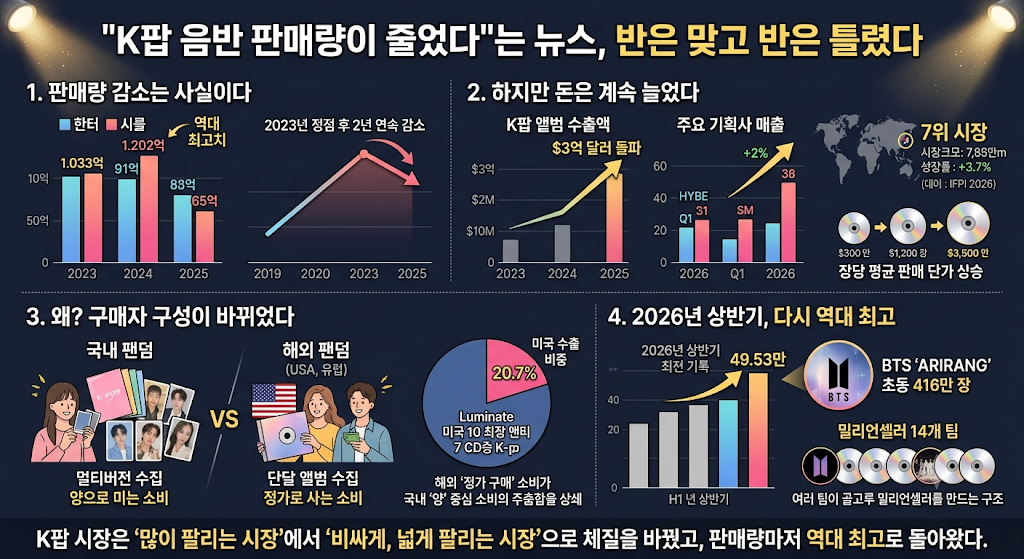
"K팝 앨범 판매량이 무너지고 있다." 2024년부터 반복된 헤드라인입니다. 실제로 숫자만 보면 틀린 말은 아닙니다. 그런데 같은 시기 K팝 앨범 수출액은 사상 처음 3,000억 원을 넘었고, 하이브와 SM의 실적은 오히려 두 자릿수로 뛰었습니다. 판매량이 줄어드는데 돈은 더 벌린다는 이 모순, 어디서 오는 걸까요.
팩트체크: 판매량이 준 건 사실이다
K팝 음반 시장은 2019년 1,857만 장에서 꾸준히 우상향하다가, 2020년 팬데믹으로 공연이 멈추자 팬들의 소비가 음반으로 몰리며 2023년 1억 330만 장이라는 역대 최고치를 찍었습니다. 문제는 그 다음입니다. 2024년과 2025년, 판매량은 2년 연속 1억 장 아래로 떨어졌습니다.
여기서 짚어야 할 게 하나 있습니다. 이 판매량을 집계하는 두 기관, 한터차트와 서클차트의 숫자가 서로 다릅니다.
| 2023 | 1억 330만 장 | 1억 2,020만 장 |
| 2024 | 8,695만 장 | 9,890만 장 |
| 2025 | 8,624만 장 | 9,350만 장 |
집계 대상과 방식이 다르기 때문에 벌어지는 차이입니다. 어느 쪽을 봐도 방향은 같습니다. 2023년을 정점으로 2년 연속 감소했다는 것. 팬데믹 시기 보복 소비가 정점을 찍은 뒤 자연스럽게 조정을 받은 셈입니다. 여기까지는 "판매량이 무너지고 있다"는 헤드라인이 사실을 말하고 있습니다.
그런데 돈은 계속 늘었다
같은 기간, 전혀 다른 그래프가 그려지고 있었습니다.
- K팝 앨범 수출액은 2025년 처음으로 3억 달러(약 3,000억 원)를 넘어섰습니다. 사상 최고치입니다.
- 2026년 1분기 수출액은 전년 동기 대비 159% 증가한 1억 2,000만 달러로, 분기 기준 역대 최고를 기록했습니다.
- 하이브는 2026년 1분기 매출 6,983억 원(전년 대비 +40%)을 올렸고, 이 중 음반·음원 매출만 2,715억 원이었습니다.
- SM엔터테인먼트도 같은 분기 매출 2,791억 원, 영업이익 386억 원을 기록했습니다.
- 국제음반산업협회(IFPI)가 발표한 「글로벌 뮤직 리포트 2026」에 따르면 2025년 전 세계 음반 시장 매출은 317억 달러로 전년보다 6.4% 성장했습니다. 11년 연속 성장이자 처음으로 300억 달러를 넘은 해입니다. 이 표에서 한국은 미국, 일본, 영국, 중국, 독일, 프랑스에 이어 세계 7위 시장에 올라 있습니다.
판매량은 줄었는데 매출은 늘었다는 게 단순한 착시가 아니라는 뜻입니다. 그렇다면 답은 하나입니다. 같은 장수를 팔아도 예전보다 더 비싸게, 혹은 더 비싼 시장에서 팔고 있다는 것.
왜 이런 일이 벌어지나 — 사는 사람이 바뀌었다
한국의 K팝 팬덤은 오랫동안 '멀티버전 수집'이라는 독특한 소비 방식으로 판매량을 밀어 올려왔습니다. 같은 앨범을 버전별로, 멤버별 포토카드를 노리고 여러 장씩 사는 방식입니다. 이 소비가 팬데믹 시기 절정에 달하며 2023년의 1억 장 돌파를 만들었습니다. 이 방식은 '장수'는 많이 늘리지만 장당 단가는 할인·이벤트에 크게 흔들립니다.
반면 해외, 특히 미국·유럽 팬들의 소비 패턴은 다릅니다. Luminate의 조사에 따르면 미국 K팝 슈퍼팬의 73%가 실물 음반을 구매하는데, 이들은 한국·중국에서 흔한 대량 할인이나 캠페인성 구매 없이 대체로 정가에 앨범을 삽니다. 미국은 이제 K팝 앨범 수출액의 20.7%를 차지하는 단일 국가로는 최대 시장이 됐고, Luminate 2024년 연말 보고서에 따르면 미국 내 CD 판매 상위 10개 앨범 중 7개가 K팝 앨범이었습니다.
정리하면 이렇습니다. 국내 팬덤의 '양으로 미는' 소비가 주춤한 사이, 해외의 '정가로 사는' 소비가 그 자리를 채우고 있습니다. 장수는 줄어도 평균 판매 단가가 오르니, 매출과 수출액은 오히려 늘어나는 구조입니다. IFPI 리포트도 이 흐름을 뒷받침합니다. 2025년 전 세계 실물 음반 매출의 45.1%가 아시아에서 나왔고, 아시아 시장은 10.9% 성장한 반면 미국·캐나다는 3.5% 성장에 그쳤습니다. 앞으로도 실물 음반이라는 수익화 창구가 아시아를 중심으로 계속 힘을 받을 가능성이 크다는 뜻입니다.
2026년 상반기, 판매량도 다시 역대 최고를 찍었다
여기에 하나가 더 겹쳤습니다. 판매량 자체도 다시 반등했습니다. 한터차트에 따르면 2026년 상반기 K팝 음반 판매량은 4,953만 장으로, 기존 최고치였던 2023년 상반기(4,617만 장)를 넘어선 역대 최고 상반기 기록입니다. 전년 동기(4,012만 장) 대비로는 23.4%, 약 940만 장이 늘었습니다.
이 반등을 이끈 건 군 복무를 마치고 완전체로 돌아온 방탄소년단의 정규 5집 'ARIRANG'입니다. 발매 첫 주 판매량(초동)만 416만 장을 기록했습니다. 그런데 더 눈에 띄는 대목은 방탄소년단을 빼고 봐도 시장이 튼튼했다는 점입니다. 초동 판매량 100만 장을 넘긴 밀리언셀러 음반이 14개 팀에 달했는데, 2023년 상반기에는 이 기록을 세븐틴과 스트레이 키즈, 단 2팀만 세웠습니다. 특정 메가 IP 하나에 시장이 쏠리는 구조에서, 여러 팀이 골고루 밀리언셀러를 만드는 구조로 바뀌고 있다는 신호입니다.
판매량 하나로 K팝 시장을 재단하면 안 되는 이유
지금까지의 그림을 한 문장으로 요약하면 이렇습니다. 2023년 정점 이후 2년간 판매량이 줄어든 건 사실이지만, 그 사이 시장은 '많이 팔리는 시장'에서 '비싸게, 넓게 팔리는 시장'으로 체질을 바꿨고, 2026년 들어서는 판매량마저 역대 최고치로 돌아왔습니다.
"판매량이 줄었다"는 문장만 떼어 놓으면 위기처럼 보이지만, 수출액과 구매자 구성까지 함께 보면 오히려 성장통을 지나 더 단단해진 시장이 보입니다. K팝 산업을 숫자로 읽을 때, 판매량 하나만 보고 결론을 내리면 절반의 그림만 보게 되는 이유가 여기에 있습니다.
이 글은 2026년 7월 기준 공개된 자료를 바탕으로 작성했습니다. 음반 판매량은 집계 기관(한터차트·서클차트)에 따라 수치가 다르며, 본문에서는 두 기관의 수치를 함께 표기했습니다.
Here is the full English translation of the provided text:
"K-pop album sales are collapsing." This headline has been repeated endlessly since 2024. Looking strictly at the numbers, it isn't entirely false. Yet during the exact same period, K-pop album export value surpassed 300 billion KRW for the first time in history, while the financial performances of major agencies like HYBE and SM surged by double digits. Where does this paradox—earning more money while selling fewer physical units—come from?
Fact-Check: Sales Have Indeed Declined
The K-pop physical album market grew steadily from 18.57 million units in 2019. When live concerts came to a halt during the 2020 pandemic, fan spending shifted heavily toward physical records, reaching an all-time peak of 103.3 million units in 2023.
The problem came right after: in 2024 and 2025, total sales dropped below the 100-million mark for two consecutive years.
There is one important nuance to point out: the two main tracking institutions in South Korea, Hanteo Chart and Circle Chart, report different numbers.
| Year | Hanteo Chart | Circle Chart |
| 2023 | 103.3 Million Units | 120.2 Million Units |
| 2024 | 86.95 Million Units | 98.9 Million Units |
| 2025 | 86.24 Million Units | 93.5 Million Units |
This disparity stems from differing coverage scopes and calculation methodologies. Nevertheless, both charts point in the exact same direction: a two-year consecutive decline following the 2023 peak. It represents a natural market correction after the revenge spending of the pandemic era ran its course. Up to this point, the headline "sales are collapsing" aligns with the facts.
...Yet Revenues Kept Growing
During the same timeframe, a completely different trend line emerged.
- K-pop album export value topped $300 million USD (approx. 300 billion KRW) for the first time in 2025—an all-time high.
- In Q1 2026, export revenue reached $120 million USD—a 159% surge year-over-year and a quarterly historical record.
- HYBE generated 698.3 billion KRW in Q1 2026 revenue (+40% YoY), with recorded music/digital music alone contributing 271.5 billion KRW.
- SM Entertainment recorded 279.1 billion KRW in revenue and 38.6 billion KRW in operating profit during the same quarter.
- According to the International Federation of the Phonographic Industry's (IFPI) Global Music Report 2026, total global recorded music revenue reached $31.7 billion USD in 2025—a 6.4% YoY growth. This marked 11 consecutive years of expansion and the first time the market broke the $30-billion threshold. South Korea stood as the 7th largest market globally.
This proves that rising revenues despite falling unit sales are not a mere illusion. The explanation is simple: albums are being sold at higher average price points, or in markets with higher purchasing power.
Why Is This Happening? The Consumer Profile Shifted
Historically, the domestic K-pop fandom drove up physical sales volumes through a unique consumer behavior: multi-version collecting. Fans bought multiple copies of the exact same album to collect different member photo cards or variant covers. This trend peaked during the pandemic, driving total sales past 100 million in 2023. While this method inflates unit counts, average per-album profit margins remain vulnerable to heavy discounts and promotional events.
Conversely, international fans—particularly in the US and Europe—exhibit a different purchasing pattern. According to research by Luminate, 73% of US K-pop super-fans purchase physical albums. Rather than participating in mass-discount campaigns or bulk-buying common in Korea and China, they predominantly buy albums individually at full retail price. The US has grown into the single largest market for K-pop album exports, accounting for 20.7% of total export value. Luminate's 2024 Year-End Report showed that 7 out of the top 10 top-selling physical CD albums in the United States were K-pop titles.
In short: as volume-driven domestic consumption cooled down, full-price international consumption stepped in to fill the gap. Even if unit counts dip, the higher average selling price (ASP) drives total revenue and export values upward. IFPI data corroborates this trajectory: in 2025, 45.1% of global physical album revenue originated in Asia (growing by 10.9%), whereas North America grew by only 3.5%. Physical records are poised to remain a powerful monetization engine centered around the Asian market.
Sales Volumes Hit New All-Time Highs in H1 2026
Adding another layer to this shift, overall unit sales have rebounded dramatically. According to Hanteo Chart, K-pop album sales in the first half of 2026 hit 49.53 million units, eclipsing the previous H1 record of 46.17 million units set in 2023. This marks a 23.4% YoY increase (up approximately 9.4 million units) compared to H1 2025 (40.12 million units).
This rebound was largely catalyzed by BTS's 5th full-length studio album, ARIRANG, released following the completion of all members' mandatory military service. The album logged 4.16 million copies sold in its first week alone (first-week sales).
More importantly, the market demonstrated structural resilience even when looking beyond BTS. A total of 14 different artists achieved "million-seller" status (exceeding 1 million copies in first-week sales) in H1 2026. By comparison, only two teams—SEVENTEEN and Stray Kids—achieved this milestone in H1 2023. The industry is transitioning from a fragile structure dependent on a single mega-IP to a healthier ecosystem where multiple groups consistently generate million-selling records.
Why Unit Sales Alone Don't Tell the Full Story
Summarizing the full picture in a single sentence: while it is true that physical unit sales dropped for two years following the 2023 peak, the K-pop market transformed during that period from a "high-volume market" into a "higher-margin, broader-reach market"—and by 2026, absolute sales volumes returned to record highs as well.
Isolating the statement "sales have fallen" makes it look like a crisis. But evaluating unit numbers alongside export revenues and buyer demographics reveals a market that has weathered its growing pains and emerged stronger. Judging the health of the K-pop industry purely by physical unit sales covers only half the picture.
This article was prepared based on publicly available data as of July 2026. Album sales statistics vary depending on the tracking agency (Hanteo Chart vs. Circle Chart); figures from both institutions have been provided for accuracy.
참고 자료
- 한터글로벌, "2026 상반기부터 뜨겁다! K-POP 음반 판매량 역대 최고치 경신" (2026.7.8)
- 이투데이, "한터차트, 올 상반기 K팝 음반 판매량 4953만 장⋯역대 최고" (2026.7.8)
- 미주 한국일보, "올해 상반기 K팝 음반 4953만장 팔렸다..역대급 호황" (2026.7.19)
- 헤럴드경제, "'K-팝 황금기' 다시 돌아오나…1~5월 음반 판매 '역대 최다'" (2026.7)
- Chaos and Order, "K-pop은 왜 7위 시장의 몸집보다 커 보이는가: IFPI 2026으로 읽는 음악 경제" (2026.7.11)
- 글로벌이코노믹, "[집중분석] 글로벌 음악시장, 2035년까지 278조 원 돌파" (2025.9.8)
- 코리아타임스, "K-pop album exports top $300 mil. in 2025 for 1st time" (2026.1.16)
- 서클차트 분석, "K-팝 보이그룹 앨범 판매량 하락 2026" (2026.6.7)
- Calywire, "미국 K-Pop 앨범·굿즈 시장, 5억 달러 규모 진입 – 2025 수출전략 데이터 리포트" (2026.1.10)


