1. 서론: 분당 62.5곡, 'AI 음악 50%' 시대의 개막
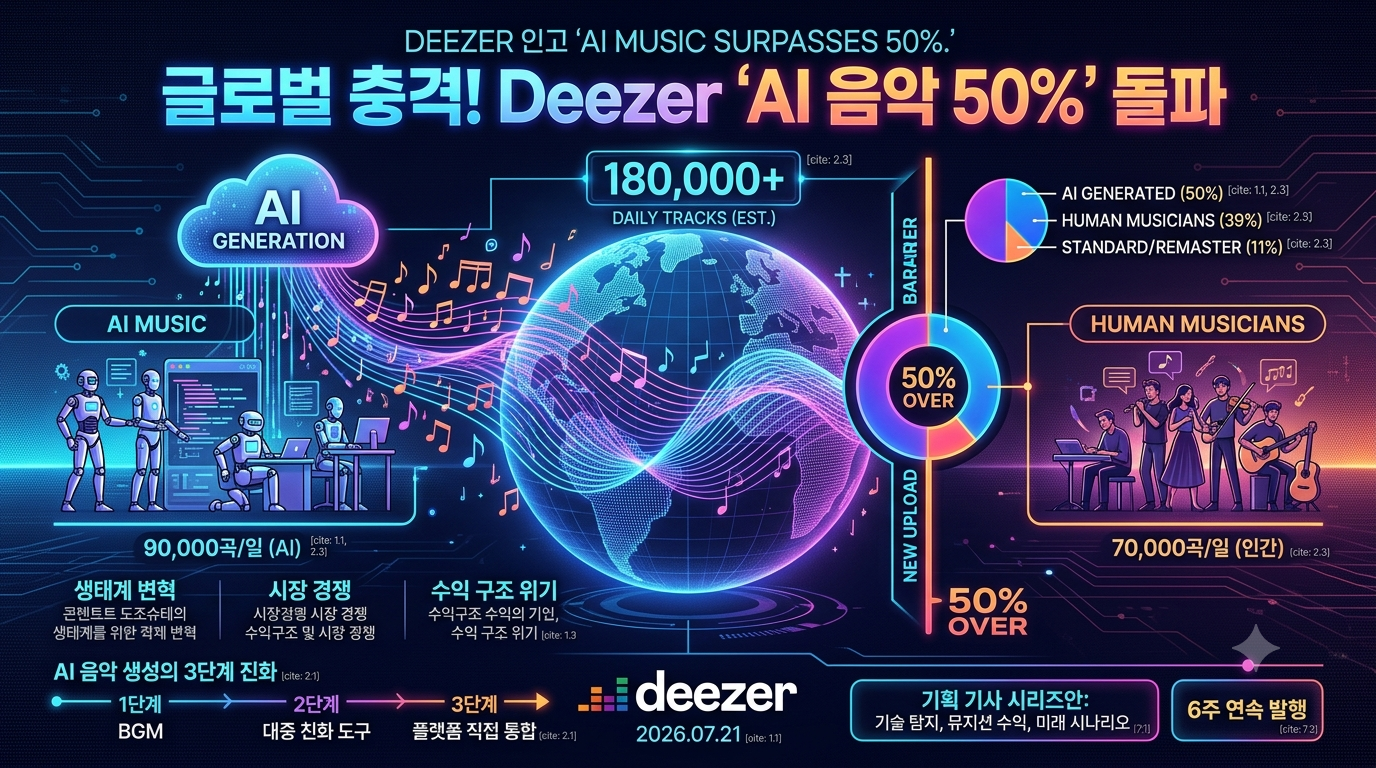
2026년 7월 21일, 프랑스 기반의 글로벌 음악 스트리밍 플랫폼 Deezer가 발표한 데이터는 전 세계 음악 산업 전체에 커다란 충격을 안겨주었습니다. 하루 평균 신규 업로드 음원 중 무려 50% 이상(약 90,000곡)이 AI 생성 음원이라는 사실이 공식 확인되었기 때문입니다.
이는 분당 62.5곡, 시간당 3,750곡에 달하는 엄청난 물량입니다. 과거 인간 창작자들의 전유물이었던 음원 스트리밍 플랫폼이 불과 수년 만에 AI 생성 콘텐츠와 인간 크리에이터가 치열하게 지분을 다투는 공간으로 변모했습니다. Deezer의 "50% 돌파" 선언은 단순한 통계 발표를 넘어 음악 생태계의 판도가 근본적으로 바뀌었음을 알리는 역사적 분기점입니다.
2. '90,000곡/일' 폭증의 구조적 배경
왜 지금 이토록 폭발적인 AI 음원 유입이 발생하는가? 기획안 분석 결과, 이는 단순한 호기심을 넘어선 구조적·경제적 원인에서 비롯되었습니다.
- 생성 도구의 완성도 급증 및 대중화
- 2023년 이전에는 품질 미달로 거절당하던 AI 음원이 2024~2026년에 이르러 텍스트 명령어(Prompt) 몇 줄만으로 상업 음원 수준의 완성도를 갖추게 되었습니다.
- 수익 기대 심리와 '스팸' 전략
- AI로 곡 1개를 생성하는 데 걸리는 시간은 30초~5분, 비용은 $1 미만에 불과합니다.
- 스트리밍 1회당 약 $0.003~$0.005의 정산금을 노리고, 수천~수만 곡을 대량 업로드하여 롱테일 수익을 올리려는 스팸성 업로더가 급증했습니다.
- 플랫폼 검수 시스템의 한계
- 전통적인 음원 배포 체계는 생성 단계에서의 AI 메타데이터 검증이나 실시간 자동 거부 시스템을 완벽히 갖추지 못했습니다.
- 글로벌 자동화 업로드 네트워크
- 한국, 중국, 인도 등 글로벌 전역에서 봇과 다중 계정을 활용한 대량 업로드 활동이 조직화되었습니다.
3. Deezer의 대응: 탐지 기술과 정책적 실험
Deezer가 이 수치를 전격 공개한 것은 '투명성을 통한 신뢰 구축'과 'AI 탐지 기술 리더십 선점'을 노린 전략적 행보입니다.
3.1. AI 음악 탐지 기술 분석
Deezer는 현재 다중 레이어 탐지 시스템을 도입하여 필터링을 추진하고 있습니다.
- 메타데이터 검증: ISRC 코드, 작곡가 정보 및 중복 패턴 검사 (우회 용이성이라는 한계 존재).
- 오디오 지문(Audio Fingerprinting): 음향 서명 비교를 통한 중복곡 탐지 (신규 생성 AI곡은 구분 불가능).
- 주파수 & Vocoder 신경망 분석: AI 음원 특유의 특정 주파수 대역 부자연성과 음성 합성 신호 감지 (정확도 70~90%).
- 위양성(False Positive) 위험 [한계점]: 정당한 인간 뮤지션의 곡을 AI로 오판하여 삭제하는 부작용 및 실시간 검사에 따른 막대한 서버 비용 발생.
3.2. 정책적 대응: 차등 보상제 도입 검토
Deezer는 AI 음원의 무분별한 침식을 막기 위해 로열티 차등지급 모델을 검토 중입니다.
- 순수 인간 곡: 100% 로열티 정산
- 하이브리드(인간+AI): 70% 로열티 정산
- 순수 AI 곡: 50% 로열티로 감액 정산
- 미라벨링/스팸 곡: 정산 제외 및 계정 제재
4. 음악 산업 파장 및 2029년 미래 시나리오
4.1. 뮤지션 수익의 극심한 희석
스트리밍 정산 체계(Pro-Rata) 특성상 전체 재생 파이는 한정되어 있는데 AI 곡이 50%를 점유하면, 개별 인간 뮤지션의 기대 수익은 약 47% 이상 급감하게 됩니다. 곡을 2배 더 많이 만들어야 이전과 같은 수익을 얻는 구조적 불평등이 심화됩니다.
4.2. 3년 후(2029년) 생태계 3대 시나리오
- 시나리오 A (AI 폭증 / 확률 30%): 규제 실패로 AI 음원이 70~80% 점유. 뮤지션 수익 파탄 및 플랫폼의 평범한 음원 오염.
- 시나리오 B (규제 개입 / 확률 40%): EU AI Act 등 각국 정부의 라벨링 의무화 및 강경한 필터링으로 AI 음원을 20~30% 선에서 통제.
- 시나리오 C (Tier 기반 공존 / 확률 30%): 순수 인간(Tier 1), 협업(Tier 2), AI 실험실(Tier 3) 등으로 구획을 명확히 나눈 상생 생태계 구축.
1. Introduction: 62.5 Tracks per Minute, the Dawn of the "50% AI Music" Era On July 21, 2026, data released by the France-based global music streaming platform Deezer sent shockwaves through the worldwide music industry. It was officially confirmed that over 50% (approx. 90,000 tracks) of the daily average of new music uploads were AI-generated content.
This equates to a staggering volume of 62.5 tracks per minute and 3,750 tracks per hour. Music streaming platforms, once the exclusive domain of human creators, transformed in just a few short years into a battleground where AI-generated content and human creators fiercely compete for market share. Deezer's announcement of crossing the "50% mark" is more than a simple statistical report—it represents a historical turning point signaling a fundamental shift in the music ecosystem.
2. Structural Background Behind the "90,000 Tracks/Day" Surge Why is this explosive influx of AI music happening right now? Analysis reveals that this stems from structural and economic factors far beyond simple curiosity.
- Rapid Advancement and Democratization of Generation Tools: AI tracks that were rejected prior to 2023 due to poor quality reached commercial-grade execution between 2024 and 2026 using just a few lines of text prompts.
- Profit Expectations and Spam Strategies: Generating a track with AI takes only 30 seconds to 5 minutes at a cost under $1. Spam uploaders skyrocketed, uploading tens of thousands of tracks in bulk to capture long-tail royalties targeting payout rates of ~$0.003 to $0.005 per stream.
- Limitations of Platform Screening Systems: Traditional music distribution networks lacked robust metadata verification for AI at the creation stage or real-time automated rejection systems.
- Global Automated Upload Networks: Mass uploading using bots and multi-account networks became organized across global regions including Korea, China, and India.
3. Deezer’s Response: Detection Technology and Policy Experiments Deezer's decision to disclose these figures is a strategic move aimed at building trust through transparency and establishing leadership in AI detection technology.
3.1. Analysis of AI Music Detection Technology Deezer is currently implementing a multi-layered detection system for filtering:
- Metadata Verification: Inspecting ISRC codes, composer details, and duplicate patterns (limitation: easily bypassed).
- Audio Fingerprinting: Identifying duplicate tracks through acoustic signature comparisons (limitation: incapable of detecting newly generated AI tracks).
- Frequency & Vocoder Neural Network Analysis: Detecting unnatural specific frequency bands and synthetic speech signals unique to AI tracks (accuracy: 70–90%).
- False Positive Risks [Limitation]: Side effects such as misidentifying and deleting legitimate human musicians' works as AI, along with massive server costs driven by real-time inspection.
3.2. Policy Responses: Considering Tiered Compensation To prevent the indiscriminate erosion caused by AI music, Deezer is reviewing a differential royalty payout model:
- 100% Human Tracks: 100% royalty payout
- Hybrid (Human + AI): 70% royalty payout
- Pure AI Tracks: Reduced to 50% royalty payout
- Unlabeled/Spam Tracks: Excluded from payout and subject to account penalties
4. Music Industry Impact and 2029 Future Scenarios
4.1. Severe Dilution of Musician Revenue Under the current proportional (Pro-Rata) streaming payout system, the total revenue pool is fixed. With AI tracks capturing 50% of streams, expected revenues for individual human musicians drop sharply by over 47%. This deepens structural inequality, forcing creators to produce twice as many tracks just to earn what they did before.
4.2. Three Ecosystem Scenarios for 3 Years Out (2029)
- Scenario A (AI Explosion / 30% Probability): Regulatory failure leads to AI music capturing 70–80% share. Musician earnings collapse, and platforms suffer severe catalog pollution.
- Scenario B (Regulatory Intervention / 40% Probability): Government mandates such as the EU AI Act and strict filtering keep AI music controlled at around 20–30%.
- Scenario C (Tier-Based Coexistence / 30% Probability): A sustainable ecosystem is established with clear segregation between Pure Human (Tier 1), Collaborative (Tier 2), and AI Lab (Tier 3).

