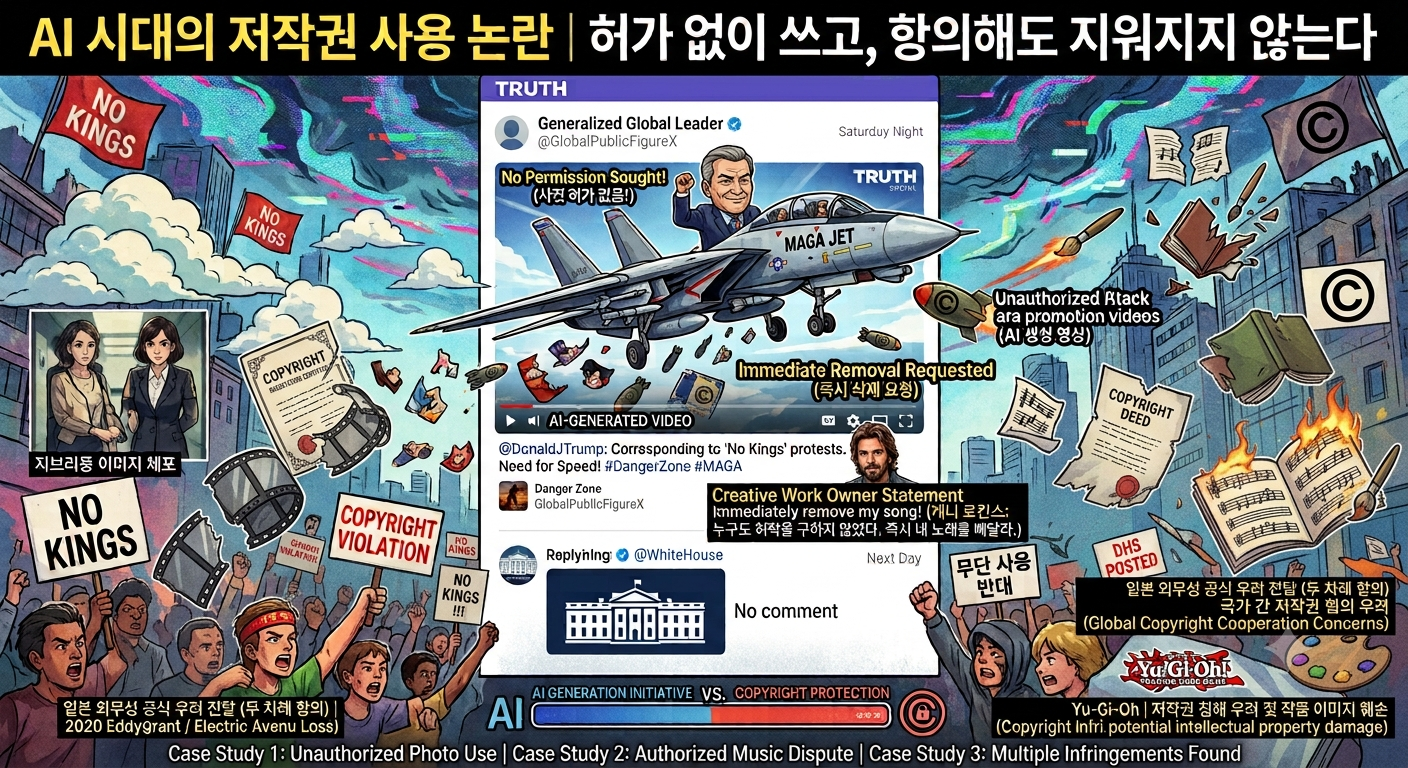
토요일 밤 트루스소셜에 영상 하나가 올라왔다. 왕관을 쓴 트럼프 대통령이 전투기를 몰고 시위대 위로 무언가를 투하하는 AI 생성 영상이었다. 배경음악은 영화 '탑건'의 명곡 '데인저 존(Danger Zone)'. 전국에서 벌어진 '노 킹스(No Kings)' 시위에 대한 대응이었다.
노래를 부른 케니 로긴스는 다음 날 성명을 냈다. "누구도 내게 허락을 구하지 않았다. 구했다면 거절했을 것이다." 그는 영상에서 자신의 노래를 즉시 빼달라고 요청했다.
백악관의 반응은 사과가 아니었다. 취재 요청에 대한 답변으로 돌아온 건 탑건의 명장면 사진 한 장, "속도가 필요해(I feel the need for speed)"라는 대사 한 줄이었다. 로긴스의 항의 다음 날에도 영상은 트루스소셜에 그대로 남아 있었다.
이 장면 하나가 지금 벌어지고 있는 일을 압축해서 보여준다. 허락을 구하지 않고 콘텐츠를 만들어 올리고, 권리자가 항의해도 게시물이 그대로 남아 있는 경우가 적지 않다. 이런 사례가 최근 1~2년 사이 여러 건 반복해서 보도되고 있다.
"몰라서"에서 "알면서도"로
트럼프의 저작권 무단 사용 논란은 새삼스러운 일이 아니다. 2016년 대선 캠프는 시리아 난민을 스키틀즈 사탕에 비유하는 트윗에 한 사진작가의 사진을 무단으로 썼다가 소송을 당했다. 같은 해 독수리 사진을 무단 게재한 것을 두고도 자연 사진가들에게 소송을 당했다. 2020년에는 가수 에디 그랜트의 곡 '일렉트릭 애비뉴'를 애니메이션 캠페인 광고에 무단으로 썼다가 4년 뒤 법원에서 패소했다. 재판부는 이 사용이 정치 광고라는 이유만으로 공정이용을 인정하지 않은 게 아니라, 원곡을 얼마나 변형했는지, 어떤 목적으로 썼는지, 원곡 시장에 어떤 영향을 미치는지 등 여러 요소를 종합적으로 따져 공정이용에 해당하지 않는다고 판단했다.
이때까지는 그래도 "개별 사건"에 가까웠다. 그런데 2024년 아이작 헤이즈 유족 사건은 성격이 달랐다. 유족 측은 "홀드 온, 아임 커밍"이라는 곡이 2022년부터 2024년까지 최소 133차례 무단으로 사용됐다고 주장했다(정확한 횟수는 유족 측 주장에 근거한 것으로, 법원이 별도로 확정한 수치는 아니다). 한두 번의 실수가 아니라 반복된 사용이라는 주장인 셈이다. 300만 달러의 라이선스 비용을 요구했고, 결국 소송으로 이어졌다가 2026년 2월 비공개 합의로 마무리됐다.
몰라서 벌어진 일이라 보기 어려운 규모다. 그리고 여기서 AI가 끼어들면서 상황은 한 단계 더 나아간다.
AI가 "허락을 구하는 절차"를 건너뛰게 했다는 지적
2025년 3월, 챗GPT의 이미지 생성 기능이 인기를 끌면서 스튜디오 지브리풍 이미지가 SNS를 뒤덮었다. 백악관 공식 계정도 이 흐름에 동참했다. 필라델피아에서 마약 밀매 혐의로 체포된 한 여성의 모습을 지브리풍 이미지로 만들어 게시한 것이다. 다만 이 사안을 저작권 침해로 볼 수 있는지는 아직 결론이 난 문제가 아니다. 특정 화풍 자체는 원칙적으로 저작권 보호 대상이 아니라는 견해가 우세하지만, 일부 전문가들은 AI가 지브리 작품을 학습 데이터로 사전 동의나 대가 지급 없이 사용했을 가능성을 지적하며 별도의 침해 소지가 있다고 주장한다. 이는 아직 법적으로 다퉈지지 않은, 해석이 엇갈리는 지점이다.
몇 달 뒤에는 일본의 대표 애니메이션 캐릭터들이 잇따라 등장했다. 2025년 9월 미국 국토안보부(DHS)는 불법 이민자 단속을 홍보하며 포켓몬 주인공 사토시(한국명 지우)가 몬스터볼을 던지는 장면과 "모두 잡아야 돼(Gotta catch them all)"라는 문구를 넣은 영상을 X에 올렸다. 체포된 이민자들의 모습이 포켓몬 카드 형태로 등장하는 장면도 포함됐다. 2026년 3월에는 미국과 이란의 무력 충돌 이후 백악관이 대(對)이란 공격을 홍보하는 영상에 아이언맨, 탑건 같은 미국 콘텐츠와 함께 유희왕·드래곤볼 캐릭터를 사용했고, 같은 달 포켓몬 게임 이미지를 'MAGA(Make America Great Again)'와 합성한 이미지도 게시했다. 포켓몬 제작사는 이 이미지 제작이나 배포에 자사가 관여하지 않았으며 특정 정치적 견해와도 무관하다는 공식 입장을 냈다. 6월에는 트럼프 대통령이 자신의 트루스소셜에 나루토 주인공과 자신의 얼굴을 합성한 영상을 올렸다.
일본 외무성은 4월과 6월, 두 차례에 걸쳐 주일 미국대사관에 공식적으로 우려를 전달했다. 공공기관이라도 지식재산을 쓸 때는 제작사의 사전 허가가 필요하다는 점을 강조하며 저작권 침해 가능성과 작품 이미지 훼손 우려를 전달한 것으로 전해졌다. 유희왕 제작사는 성명을 내고 자사 캐릭터가 권리자 허락 없이 백악관 SNS 계정에 쓰인 사실을 공개적으로 문제 삼았고, 팬들은 온라인 청원까지 벌였다.
그런데도 문제가 된 영상 중 대부분은 지금까지 그대로 남아 있다. 일부만 유튜브에서 비공개로 전환됐을 뿐, 미국 정부와 트럼프 대통령의 주요 SNS 계정에서는 삭제되지 않았다. 마이니치신문은 일본 정부 관계자를 인용해, 지식재산권 보호를 강조해온 미국이 최근에는 정권 홍보를 우선시하며 이를 경시하고 있다는 비판적 시각을 전했다.
여기에 케니 로긴스의 '데인저 존' 사건까지 더하면 하나의 흐름이 보인다. AI 생성 도구는 이미지든 음악이든 순식간에 조합해서 완성된 콘텐츠를 만들어낸다. 만드는 속도가 워낙 빠르다 보니 "이거 써도 되나?"를 확인하는 절차가 끼어들 틈이 상대적으로 줄어든다는 지적이 나온다. 다만 이를 "침해가 제작 방식 자체에 내장돼 있다"고 단정하는 것은 아직 사실 확정이라기보다는 하나의 해석이자 논쟁적인 진단에 가깝다. 반복적인 무단 사용이 우연이나 실수보다는 절차상의 허점 때문이라는 정황은 있지만, 이를 인과관계로 못박기엔 아직 근거가 충분치 않다.
항의해도 소용없다는 학습효과
더 눈에 띄는 건 항의 이후의 태도다. 정부 대 정부 채널로 두 차례나 공식 항의를 전달한 일본조차 게시물을 지우게 하지 못했다. 개별 아티스트의 항의는 그보다 힘이 약할 수밖에 없다. 지난 10년간 셀린 디온, 퀸, 비욘세, 아바, 푸 파이터스, 화이트 스트라입스, 시네이드 오코너, 브루스 스프링스틴, 아델 등 수많은 아티스트가 자신의 곡을 쓰지 말라고 요구했지만 실제로 삭제나 사용 중단으로 이어진 경우는 드물다.
실제로 법정까지 가서 결과가 난 건 소수다. 에디 그랜트는 소송에서 이겼고, 아이작 헤이즈 유족은 합의로 끝냈다. 나머지 대다수는 항의만 남긴 채 흘러갔다. 소송을 걸 만큼의 자원과 의지가 있는 권리자만 결과를 얻어낸다는 뜻이다.
결국 남는 질문
백악관이 로긴스의 항의에 소송이 아니라 밈으로 답했다는 사실이 많은 것을 말해준다. 법적 리스크보다 무서운 건 여론의 반응인데, 지금까지는 그 반응조차 콘텐츠를 지우게 할 만큼 강하지 않았다.
콘텐츠를 만드는 속도가 저작권을 확인하는 속도를 이미 앞질렀다면, 사후에 소송을 거는 방식으로는 이 흐름을 따라잡기 어렵다. 저작물이 게시되기 전에 걸러내는 기술, 혹은 게시된 뒤 빠르게 탐지해내는 기술 쪽으로 무게중심이 옮겨가는 건 어쩌면 자연스러운 다음 단계일지 모른다.
On Saturday night, a video was posted on Truth Social. It was an AI-generated video showing President Trump wearing a crown, flying a fighter jet, and dropping something over protesters. The background music was "Danger Zone," the iconic song from the movie Top Gun. It was a response to the "No Kings" protests taking place across the country.
Kenny Loggins, who sang the song, issued a statement the next day: "Nobody asked my permission. If they had, I would have said no." He requested that his song be removed from the video immediately.
The White House's response was not an apology. What came back as an answer to media inquiries was a single iconic frame from Top Gun and a single line of dialogue: "I feel the need for speed." Even the day after Loggins's protest, the video remained on Truth Social.
This single scene encapsulates what is happening right now. Content is created and posted without seeking permission, and even when copyright holders protest, it is not uncommon for the posts to remain online. Numerous cases like this have been reported repeatedly over the past one to two years.
From "Not Knowing" to "Knowing Full Well"
Trump's unauthorized copyright usage controversies are nothing new. In 2016, his presidential campaign was sued for using a photographer's photo without permission in a tweet comparing Syrian refugees to Skittles candy. That same year, wildlife photographers sued over the unauthorized posting of an eagle photo. In 2020, the campaign used singer Eddy Grant's song "Electric Avenue" without permission in an animated campaign ad, losing in court four years later. The court ruled that it did not constitute fair use simply because it was a political ad; instead, after comprehensively weighing various factors—such as how much the original song was transformed, the purpose of its use, and its impact on the market for the original song—it determined that fair use did not apply.
Up until then, these remained closer to "isolated incidents." However, the 2024 case involving the estate of Isaac Hayes was of a different nature. The estate claimed that the song "Hold On, I'm Comin'" was used without permission at least 133 times between 2022 and 2024 (the exact figure is based on the estate's claims and has not been separately confirmed by the court). This amounted to an argument that it was repeated usage rather than a one- or two-time mistake. They demanded $3 million in licensing fees, which ultimately led to a lawsuit that concluded in a confidential settlement in February 2026.
This scale makes it difficult to view as something that happened out of simple ignorance. And as AI enters the picture, the situation escalates even further.
Pointing to AI as Enabling the Bypassing of "Permission Procedures"
In March 2025, as ChatGPT's image generation feature gained popularity, Studio Ghibli-style images flooded social media. The official White House account joined this trend as well, posting a Ghibli-style image created of a woman arrested in Philadelphia on drug trafficking charges. However, whether this instance constitutes copyright infringement remains an unresolved question. While the prevailing view is that a specific art style itself is not subject to copyright protection in principle, some experts point out that AI may have used Ghibli's works as training data without prior consent or compensation, arguing that this poses a separate possibility of infringement. This remains a legally untested area with conflicting interpretations.
A few months later, iconic Japanese animation characters appeared in succession. In September 2025, the U.S. Department of Homeland Security (DHS) posted a video on X promoting illegal immigration crackdowns, featuring Ash Ketchum (Satoshi), the main character of Pokémon, throwing a Pokéball alongside the slogan "Gotta catch 'em all." It also included a scene where arrested immigrants were depicted in the form of Pokémon cards. In March 2026, following a military clash between the U.S. and Iran, the White House used characters from Yu-Gi-Oh! and Dragon Ball alongside American content like Iron Man and Top Gun in a promotional video for attacks on Iran, and in the same month posted an image combining a Pokémon game image with "MAGA (Make America Great Again)." The company behind Pokémon issued an official statement stating it was not involved in the creation or distribution of the image and was unaffiliated with any specific political views. In June, President Trump posted a video on his Truth Social account superimposing his face onto the main character of Naruto.
Japan's Ministry of Foreign Affairs officially conveyed its concerns to the U.S. Embassy in Japan twice, in April and June. They reportedly emphasized that even public institutions require prior authorization from creators when using intellectual property, conveying concerns over potential copyright infringement and damage to the works' brand images. The creators of Yu-Gi-Oh! issued a statement publicly raising issues over their characters being used on official White House social media accounts without permission from rights holders, while fans launched online petitions.
Nevertheless, most of the problematic videos remain online to this day. Aside from a few that were set to private on YouTube, they have not been deleted from the official social media accounts of the U.S. government and President Trump. Citing a Japanese government official, the Mainichi Shimbun shared a critical perspective that the United States, which used to emphasize intellectual property protection, has recently been disregarding it in favor of prioritizing administration PR.
Adding the Kenny Loggins "Danger Zone" incident to the mix reveals a broader pattern. AI generation tools instantly synthesize images or music to produce finished content. Because the production speed is so fast, critics point out that the opportunity to pause and verify—"Is it okay to use this?"—is relatively reduced. However, concluding that "infringement is embedded into the production method itself" is closer to a debate-worthy diagnosis and interpretation rather than an established fact. While there are circumstances suggesting that repeated unauthorized use stems from procedural loopholes rather than simple accidents or mistakes, the evidence is not yet sufficient to definitively prove direct cause and effect.
The Learned Lesson That Protests Are Futile
What is even more striking is the post-protest response. Even Japan, which conveyed official protests twice through government-to-government channels, failed to get the posts removed. Protests from individual artists naturally carry even less clout. Over the past decade, numerous artists—including Celine Dion, Queen, Beyoncé, ABBA, Foo Fighters, The White Stripes, Sinéad O'Connor, Bruce Springsteen, and Adele—have demanded that their songs not be used, but these demands have rarely resulted in actual removal or cessation of use.
In reality, only a handful of cases have gone to court and reached a resolution. Eddy Grant won his lawsuit, and the estate of Isaac Hayes concluded theirs with a settlement. The vast majority of the rest faded away, leaving only protests behind. This implies that only rights holders with sufficient resources and determination to file lawsuits ever achieve a tangible result.
The Remaining Question
The fact that the White House answered Loggins's protest with a meme rather than a legal defense speaks volumes. What should be more intimidating than legal risk is public backlash, but so far, even that response has not been strong enough to compel the removal of the content.
If the speed of content creation has already outpaced the speed of verifying copyright, relying on post-hoc litigation is unlikely to keep up with this trend. Shifting the center of gravity toward technology that filters copyrighted material before publication, or rapidly detects it after posting, may very well be the natural next step.