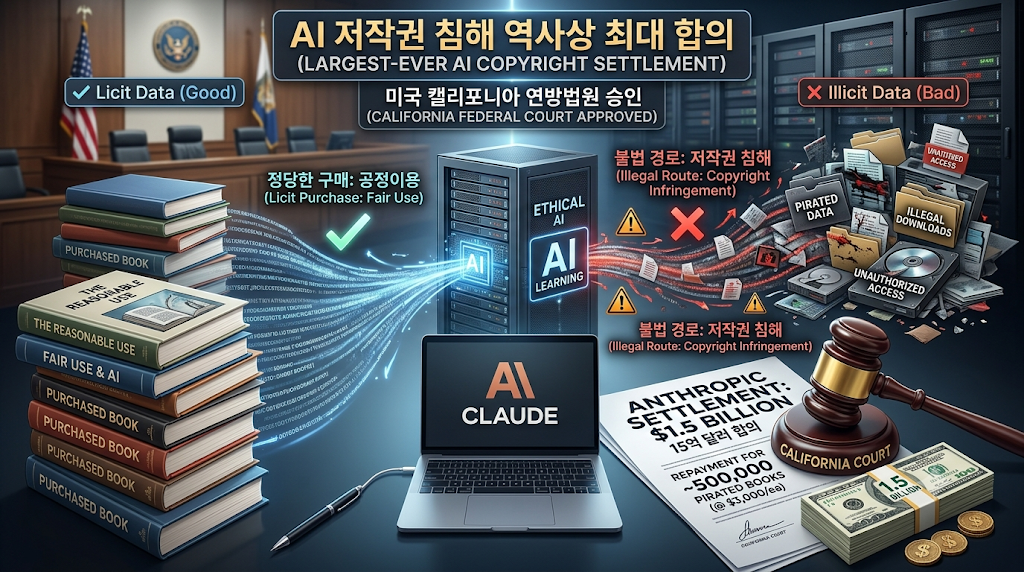
AI가 책을 읽고 공부하는 건 괜찮다. 문제는 그 책을 "어디서" 구했는가였다.
무슨 일이 있었나
챗봇 클로드를 만드는 AI 회사 앤스로픽이, 작가들과 벌이던 저작권 소송을 15억 달러(약 2조 원)에 합의하고 마무리했다. 미국 저작권 소송 역사상 가장 큰 배상 금액이다. 2026년 7월 20일, 캘리포니아 연방법원 판사가 이 합의를 최종 승인하면서 사건이 일단락됐다.
시작은 이랬다. 베스트셀러 스릴러 소설 『우리는 여기에 없었다』를 쓴 안드레아 바츠를 포함한 여러 작가들이, "앤스로픽이 우리 책을 허락도 없이 AI 학습에 갖다 썼다"며 소송을 걸었다. AI가 그럴듯한 문장을 쓰는 법을 배우려면 수많은 글을 읽어야 하는데, 그 재료 중에 자기들 책이 무단으로 들어갔다는 주장이었다.
합의 결과, 소송에 참여한 작가들은 자기 책 한 권당 약 3,000달러(약 400만 원)씩 보상금을 받게 됐다. 법원은 여기에 더해, 앤스로픽이 부적절하게 확보한 책 파일을 전부 삭제하라고도 명령했다. 다만 일부 작가와 출판사는 이번 합의에 참여하지 않고 별도로 소송을 이어가고 있어서, 이 이야기가 완전히 끝난 건 아니다.
이 사건이 흥미로운 이유는 배상금 액수 때문만이 아니다. 법원이 "AI 학습은 다 똑같이 안 된다"고 하지 않고, 딱 한 가지 기준으로 잘잘못을 갈랐기 때문이다.
법원이 그은 선: "무엇을 했나"가 아니라 "어떻게 구했나"
이번 판결에서 가장 중요한 대목은 이거다. 법원은 앤스로픽이 "AI에게 책을 읽혔다"는 사실 자체는 문제 삼지 않았다. 대신 그 책을 어떤 경로로 손에 넣었는지를 기준으로 완전히 다른 결론을 내렸다.
돈 주고 산 책으로 AI를 가르쳤다면 → 문제없음
법원은 정식으로 값을 치르고 산 책을 AI 학습에 쓰는 건 저작권법에서 허용하는 정당한 사용(공정이용, fair use)이라고 판단했다. 쉽게 말해, 서점에서 산 책을 읽고 공부하는 것과 다를 게 없다고 본 것이다. 이 판단은 이번 합의와 별개로 지금도 유효한 법적 기준으로 남아 있다. 앤스로픽 쪽 법무 담당 임원도 이 부분에 대해서는 여전히 판결이 살아있다는 점을 강조했다.
불법 사이트에서 몰래 내려받은 책으로 AI를 가르쳤다면 → 저작권 침해
반면 앤스로픽이 이른바 '해적판' 사이트, 그러니까 정식 허가 없이 책을 퍼뜨리는 불법 사이트에서 책을 내려받아 AI 학습에 쓴 부분에 대해서는, 법원이 저작권 침해 가능성이 있다고 봤다. 그리고 이 부분에 대해서만 배상 절차를 진행했다. 그렇게 확보된 책이 약 50만 권. 앤스로픽은 이 책들에 대해 권당 약 3,000달러씩, 총 15억 달러를 지급하기로 했다.
정리하면 이렇다. "AI가 책을 읽고 배우는 게 맞느냐 틀리느냐"가 아니라, "그 책을 정당하게 구했느냐, 불법으로 퍼가서 썼느냐"가 이번 사건에서 승패를 가른 진짜 기준이었다.
왜 3,000달러였을까
저작권 침해 사건에서 원래 법으로 정해진 최소 배상액은 책 한 권당 750달러다. 이번에 합의된 3,000달러는 이 최소 기준의 4배다.
소송에 참여한 작가 중 일부는 "배상금이 너무 적다"며 이의를 제기했지만, 법원은 이를 받아들이지 않았다. 법원이 밝힌 이유가 눈여겨볼 만하다. 만약 합의 없이 정식 재판까지 갔다면, 작가들이 반드시 이긴다는 보장이 없었다. 반대로 재판에서 훨씬 큰 배상 판결이 나왔더라도, 항소 등으로 다시 뒤집힐 위험이 있었다. 즉 3,000달러라는 숫자는 "이론적으로 받을 수 있는 최대 금액"이 아니라, 양쪽 다 재판이라는 도박을 피하기 위해 서로 양보해서 찾은 지점이라는 뜻이다.
실제로 앤스로픽은 법원에 낸 문서에서, 이 재판이 잘못하면 회사의 존폐 자체를 흔들 수 있다는 부담 속에서 합의를 택했다고 털어놓았다. 마침 앤스로픽이 연말(4분기)에 주식 상장(IPO)을 계획하고 있었다는 점도, 이 문제를 빨리 정리하고 싶었던 이유 중 하나로 보인다.
그래서, 이게 나(혹은 우리 회사)와 무슨 상관일까
이번 사건이 던지는 메시지는 생각보다 실생활에 가깝다. AI 회사든, AI 도구를 쓰는 일반 기업이든, 챙겨봐야 할 부분들이 있다.
- "어디서 가져왔는지"를 설명할 수 있는가. AI 학습이나 서비스에 쓴 콘텐츠(책, 기사, 이미지 등)가 정식으로 구매하거나 계약을 맺고 확보한 것인지, 아니면 출처가 불분명한 곳에서 긁어온 것인지 구분이 되는가.
- "어쩌다 보니 불법 경로가 섞여 있었다"는 변명이 통하지 않는다. 이번 사건에서 보듯, 몰랐다거나 의도치 않았다는 사정은 배상 책임 자체를 없애주지 않았다. 확인 절차를 미리 갖추는 게 결국 더 싸게 먹힌다.
- 배상 규모를 가늠해볼 수 있다. 문제가 된 콘텐츠 한 건당 750달러에서 3,000달러 수준이라는 구체적인 참고 기준이 이번에 생겼다. 만약 우리 데이터 안에 출처가 불분명한 자료가 얼마나 섞여 있는지 안다면, 최악의 경우 얼마를 물어줘야 할지 대략 계산해볼 수 있다는 뜻이다.
- 합의 하나로 끝났다고 안심할 수 없다. 이번에도 일부 작가와 출판사가 합의에 빠진 채 별도로 소송을 이어가고 있다. 한 번의 합의나 판결이 모든 위험을 없애주지는 않는다.
결국 이번 판결이 정리해준 건 하나다. "AI가 저작물을 공부해도 되느냐"라는 큰 질문은 어느 정도 답이 나왔지만, "그 재료를 어떻게 구했느냐"라는 훨씬 더 현실적인 질문이 이제 막 구체적인 배상 기준과 함께 떠올랐다는 것이다.
아직 끝나지 않은 이야기
이번 합의로 앤스로픽을 상대로 한 대표 소송은 마무리됐다. 하지만 일부 작가와 출판사는 여전히 별도 소송을 진행 중이고, 이번 사건의 배상 기준이 다른 AI 회사를 상대로 한 비슷한 소송에서도 참고 사례로 쓰일 가능성이 크다. AI와 저작권을 둘러싼 이 이야기는 이번 합의로 끝났다기보다, 이제 막 구체적인 규칙이 만들어지기 시작한 단계라고 보는 게 맞을 것이다.
본 원고는 미주조선일보 보도(2026.7.21, https://chosundaily.com/bbs/board.php?bo_table=hotclick&wr_id=34316)를 바탕으로 작성되었습니다.
What Happened?
Anthropic, the AI company behind the chatbot Claude, has settled a copyright lawsuit with authors for $1.5 billion (approx. 2 trillion KRW). This marks the largest settlement amount in the history of U.S. copyright litigation. On July 20, 2026, a California federal judge gave final approval to the settlement, bringing the case to a close for now.
It all started when a group of authors, including Andrea Bartz—author of the bestselling thriller We Were Never Here—filed a lawsuit claiming, "Anthropic used our books to train its AI without permission." To learn how to generate plausible text, AI needs to read vast amounts of material, and the authors argued that their books were illegally ingested as training data.
Under the settlement, participating authors will receive approximately $3,000 (approx. 4 million KRW) per book. Additionally, the court ordered Anthropic to delete all book files it had improperly acquired. However, the story is not entirely over, as some authors and publishers opted out of this settlement to pursue separate litigation.
This case is fascinating not just because of the sheer size of the payout, but because the court did not issue a blanket ruling that "all AI training is prohibited." Instead, it drew a clear line based on a single criterion.
The Line Drawn by the Court: Not "What It Did," but "How It Got It"
The key takeaway from this ruling is simple: the court did not take issue with the fact that Anthropic made its AI "read" books. Instead, it reached completely different conclusions based on how the company acquired those books.
- If trained on legitimately purchased books → No violation
- The court ruled that using legally purchased books for AI training constitutes "fair use" under copyright law. In simple terms, it viewed this as no different from a person buying a book at a bookstore and studying it. This determination remains a valid legal precedent separate from the settlement. An executive in Anthropic's legal department emphasized that this part of the ruling remains fully intact.
- If trained on books downloaded from illicit sites → Copyright infringement
- On the other hand, regarding books Anthropic downloaded from piracy sites—platforms that distribute books without authorization—the court found a high likelihood of copyright infringement. The settlement procedures were conducted exclusively for these works, which amounted to roughly 500,000 titles. Anthropic agreed to pay about $3,000 per book for these titles, totaling $1.5 billion.
To summarize: the core issue that decided the outcome was not "Is it right or wrong for AI to read and learn from books?" but rather "Did you acquire those books legitimately, or did you pirate them?"
Why $3,000?
Under U.S. copyright law, the statutory minimum damages for infringement is $750 per work. The $3,000 agreed upon in this settlement is four times that baseline amount.
Although some participating authors objected, arguing that the compensation was too low, the court dismissed their objections. The court's reasoning is worth noting: had the case gone to a full trial without a settlement, there was no guarantee the authors would win. Conversely, even if a trial resulted in a much higher damages award, it carried the risk of being overturned on appeal. In other words, $3,000 was not a "theoretical maximum," but rather a middle ground reached by both sides to avoid the gamble of a full trial.
In court filings, Anthropic admitted it chose to settle under the heavy burden that the trial could threaten the company's very survival. The fact that Anthropic was planning an initial public offering (IPO) in the fourth quarter of the year also appears to have fueled its desire to resolve the issue quickly.
What Does This Mean for You (or Your Company)?
The message from this case is much closer to everyday business operations than it might seem. Whether you run an AI company or simply work at an enterprise utilizing AI tools, there are key takeaways to keep in mind:
- Can you explain where your data came from?
- Can you clearly distinguish whether the content (books, articles, images, etc.) used for your AI training or services was obtained through legitimate purchases/contracts, or scraped from unverified sources?
- "It was an accident" is no longer an excuse.
- As demonstrated here, claiming ignorance or unintentional oversight does not absolve a company from financial liability. Establishing verification processes in advance will ultimately prove far cheaper.
- You can now estimate financial risk.
- A concrete benchmark of $750 to $3,000 per infringed work now exists. If you know how much data from unverified sources is mixed into your datasets, you can roughly estimate your worst-case liability.
- A single settlement doesn't eliminate all risk.
- In this instance, several authors and publishers opted out to continue independent lawsuits. A single settlement or ruling will not erase all legal exposure.
Ultimately, this ruling settled one major question: while the grand query of "Can AI study copyrighted works?" received a general green light, the far more practical question of "How did you get those materials?" has now emerged alongside concrete damages standards.
An Unfinished Story
This settlement concludes the primary class-action lawsuit against Anthropic. However, separate legal battles by opt-out authors and publishers are still underway, and the damages criteria established here will likely serve as a reference point for similar lawsuits against other AI companies. Rather than an ending, this settlement marks the beginning of an era where concrete rules surrounding AI and copyright are actively being shaped.
This draft was prepared based on reporting by The Chosun Daily (July 21, 2026, https://chosundaily.com/bbs/board.php?bo_table=hotclick&wr_id=34316).
